
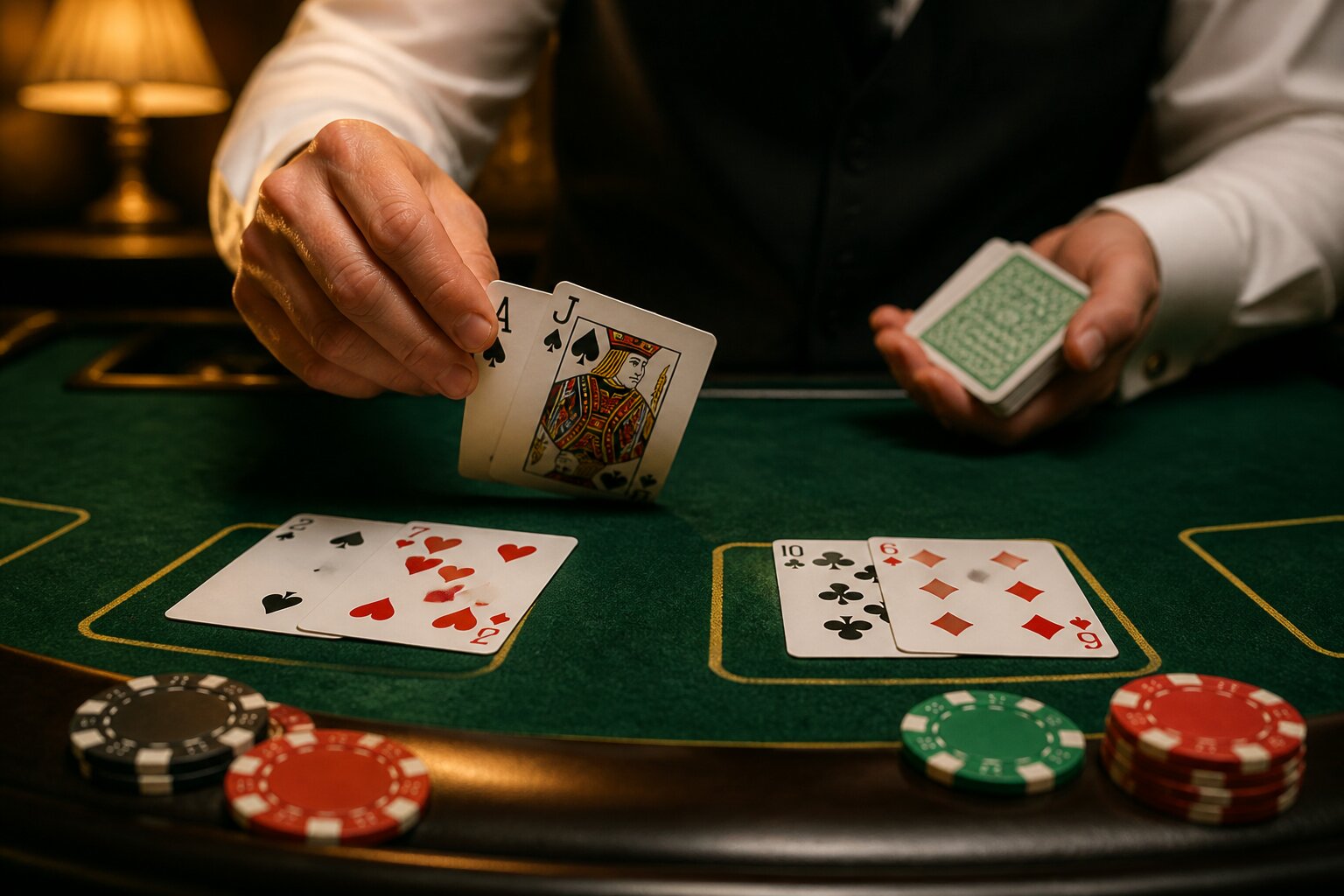
Ever wondered which starting hands give you the best position at the blackjack table and which ones demand careful attention? Knowing how hands rank helps you make clearer choices and enjoy the game with more confidence.
This guide breaks down the strongest and weakest hands, explains the role of pairs, face cards and aces, and clears up common misconceptions so you can read a table more effectively. Read on to see which hands really matter and why they do.
Understanding Blackjack Hand Basics
A blackjack hand begins with two cards dealt to each player and the dealer. The objective is to finish with a total closer to 21 than the dealer’s without exceeding 21.
Numbered cards count at face value, face cards count as 10, and aces can count as either 1 or 11, which gives them special importance. A “hard” hand has no ace counted as 11, while a “soft” hand does. For example, a 10 and an 8 is a hard 18; an ace and 7 is a soft 18 because the ace can switch between 11 and 1 if another card is drawn.
A pair occurs when the first two cards share the same value. Pairs open the option to split into two hands under many rule sets, effectively converting a single decision into two separate chances to improve your position.
Playing within preset limits and treating blackjack as entertainment helps keep the experience controlled and enjoyable. Next, we’ll identify the single strongest possible starting hand and why it stands out.
What Is the Highest Hand in Blackjack?
The highest possible hand at the start of a round is a “blackjack” or “natural”: any ace paired with a ten-value card (10, jack, queen or king). This two-card 21 beats all other totals except another blackjack.
A blackjack typically pays better than a standard win—commonly at 3:2 odds—so a successful blackjack returns more than a regular winning hand. Statistically, being dealt a blackjack occurs in just under one in twenty rounds, which is why it’s prized by players and changes the dynamics at the table when it appears.
Beyond the payout, a blackjack removes much of the guesswork from a hand: it is the clear best starting position and often ends that round in your favour. The next section explores how pairs, face cards and aces shape other hands and the choices they create.
Pairs, Face Cards & Aces: Hand Values Explained
Pairs, face cards and aces determine much of a hand’s potential from the outset, and understanding their interactions clarifies why certain hands are strong or weak.
How Pairs Affect Your Hand Strength
Receiving two identical-value cards creates strategic options. Splitting a pair turns one hand into two hands, each starting with one of the paired cards and a new card to follow. This can be a strong move when the individual card is valuable—for example, splitting aces gives two hands that can each reach 21 with one ten-value card. By contrast, splitting low pairs like two 8s converts a problematic 16 into two hands that have a much better chance of improving, rather than remaining stuck with a single weak total.
Role of Face Cards and Aces in Hand Rankings
Face cards always count as 10, so combinations of face cards form high totals such as 20, which are difficult for the dealer to beat. Aces are the most flexible card because they can be 1 or 11, turning marginal totals into safer ones. An ace with a ten-value card is a blackjack; an ace with a 7 is a soft 18, which gives room to draw without immediately risking a bust since the ace can convert to 1 if needed. Those qualities make aces central to both offence and defence at the table.
Understanding how these cards interact helps explain why certain decisions—like splitting or standing—are preferable in particular situations. The next section highlights the hands that give players the clearest advantage.
The Most Powerful Hands in Blackjack
Some starting hands place a player in a distinctly strong position. At the very top is a blackjack, the only two-card total that outranks all other hands. After that, two-card totals of 20—usually two tens or two face cards—are extremely strong because they are unlikely to be overtaken without the dealer holding a blackjack.
Totals of 19, such as 10 and 9 or ace and 8, are also solid; they allow for confident standing in most scenarios. Soft hands like ace and 9 (soft 20) or ace and 7 (soft 18) provide both a high value and flexibility: the ace’s dual value lets a player take another card with less risk of immediate busting, which can be useful against certain dealer upcards.
These hands do not guarantee success, but they reduce difficult choices and often lead to favourable outcomes. The following section turns to the hands that commonly cause the most problems at the table.
Which Blackjack Hands Are Considered Weak?
Certain totals repeatedly create difficult decisions and are often labelled weak because they place a player between the risk of busting and the need to reach a competitive number.
Hard 16 is widely regarded as the most awkward hand. It is too low to stand comfortably against a dealer showing a strong upcard, yet hitting carries a high probability of busting. Hard 15 presents a similar dilemma: marginal against the dealer, risky to improve. Hard 12 is another uncomfortable total because the next card may push the hand over 21, yet standing may leave you well short of the dealer’s final total.
Some of the difficulty around these totals comes from the dealer’s rules and actions. Learning what the dealer will do in different situations helps players set realistic expectations and choose the best response to awkward starting hands.
Hard 13 and hard 14 sit in the same uneasy range—neither allows confident standing unless the dealer’s visible card is weak, nor do they offer a safe hit. Recognising these hands helps set realistic expectations and drives more prudent decision-making under pressure. To make better choices, it helps to compare how hard and soft hands behave differently, which is covered next.
Comparing Hard and Soft Hands in Blackjack
Hard and soft hands differ primarily in flexibility. A hard hand has no ace counted as 11, so drawing a high card risks an immediate bust. As totals rise toward 21, the margin for error in hard hands narrows quickly.
Soft hands include an ace counted as 11, allowing the total to absorb a higher card without automatically busting because the ace can revert to a value of 1. This built-in safety net means soft hands often permit more aggressive play—taking another card to chase a stronger total—while hard hands typically encourage caution when totals are already high.
These structural differences affect recommended plays in many situations. Appreciating the contrast between hard and soft hands helps you weigh options more clearly and choose moves that align with how much downside exposure you might face. With that understanding, it’s helpful to clear up some persistent myths that can lead players astray.
Common Blackjack Hand Myths Debunked
Myths about blackjack hands can skew expectations and lead to suboptimal choices. Here are a few common ones explained clearly:
“Never hit on 16.”
Always refusing to hit on 16 is not a universal rule. The correct choice depends on the dealer’s upcard and the probabilities associated with drawing particular ranks from the deck. Sometimes taking a card reduces expected losses compared with standing.
“The dealer always has 10 in the hole.”
Ten-value cards are common, but they do not appear more often than their share in the remaining deck. Assuming a ten is always concealed can lead to mistaken decisions about whether to dealer or take a card.
“You’re due to win after a losing streak.”
Each round is dealt independently; past outcomes do not change the mathematical distribution of future cards. Adopting this belief can encourage risky choices.
“Perfect strategy guarantees wins.”
Following basic strategy reduces the house edge and improves long-term outcomes, but no strategy eliminates the inherent advantage that the rules give the house over repeated play.
These clarifications aim to refine expectations and reduce decisions based on incorrect ideas. Keeping strategy grounded in probabilities and clear trade-offs leads to steadier play. Overall, understanding the strongest and weakest hands, the role of aces and pairs, and how soft and hard totals behave gives a practical framework for reading the table and choosing sensible actions that match your comfort with risk.
Explore Table games at Bonanza Slots
We’re delighted to welcome you to our site, where you can enjoy a friendly and relaxed atmosphere any time you choose to play. Take your place at the tables and experience the casino in your own way, at your own pace.
It’s straightforward to get going—just create an account, make a deposit and you’ll be ready to play with us. We look forward to seeing you at the tables soon.
**The information provided in this blog is intended for educational purposes and should not be construed as betting advice or a guarantee of success. Always gamble responsibly.