
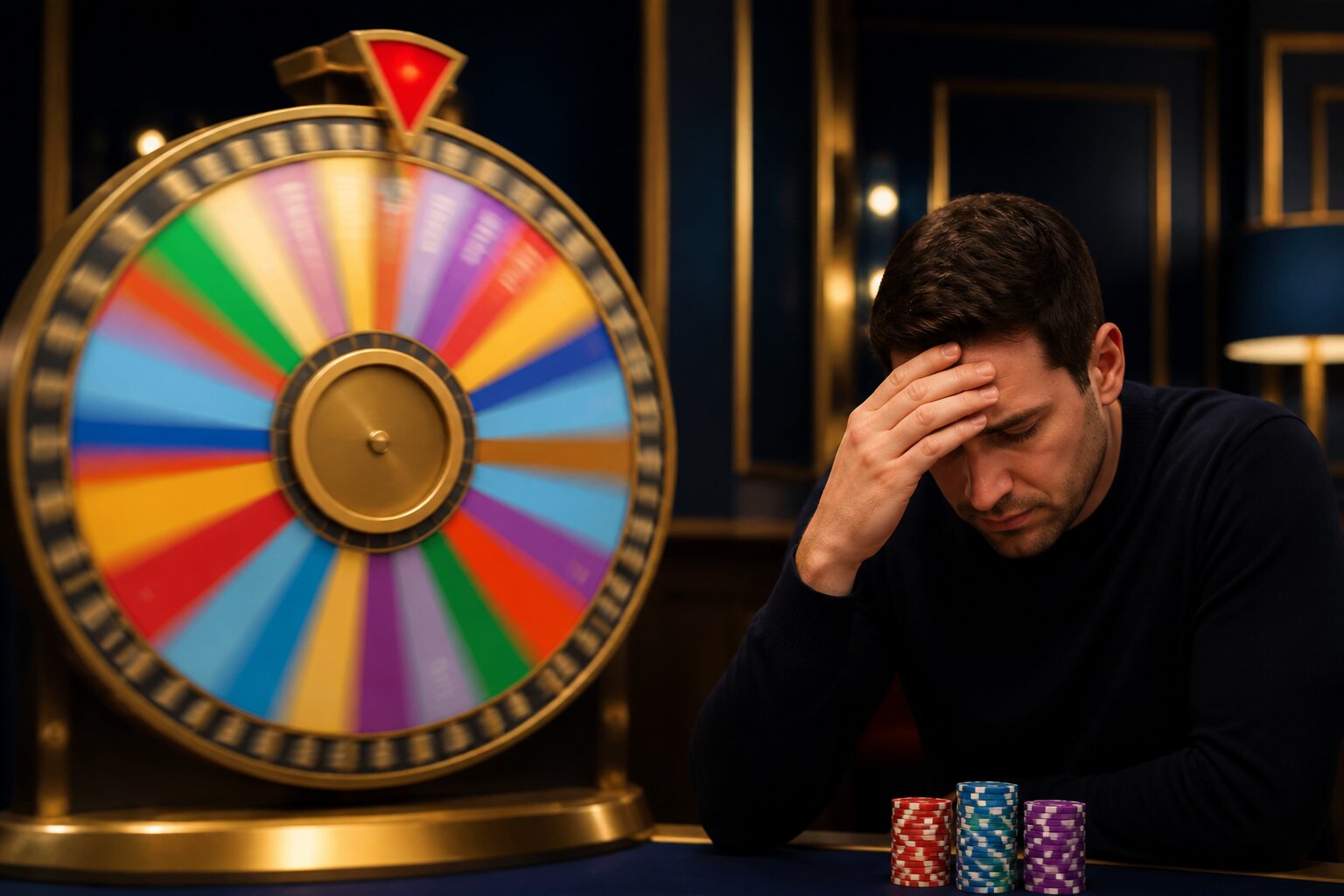
Let’s be honest, Crazy Time is one of the most exciting and colourful live casino games around. With its spinning wheel, bonus rounds and the chance of big wins, it’s easy to see why people enjoy watching and playing.
If you’ve seen guides promising “winning strategies” or shortcuts to beat the game, those claims deserve a closer look. Understanding how Crazy Time is built and regulated will show why no method can reliably overturn the house edge — and how to enjoy the game without overreaching.
Curious about the facts behind the hype? Read on to see what the game mechanics mean for players and what sensible approaches look like.
What Is Crazy Time & How Does It Work?
Crazy Time is a live game show-style casino game hosted from a studio. The central feature is a large, colourful wheel divided into 54 segments: some are numbers (1, 2, 5, 10) and others are the four bonus game sections — Coin Flip, Cash Hunt, Pachinko and Crazy Time. Players place bets on where they think the wheel will stop, and then the host spins.
If the wheel lands on a number you backed, you are paid according to that number’s odds. If it lands on a bonus segment you selected, you enter a separate mini-game with its own mechanics. Coin Flip is a two-outcome prize decision, Cash Hunt asks players to choose targets from a prize wall, Pachinko drops a puck down a pegged board, and Crazy Time takes players to a virtual board of multipliers and bonus events. Some of those bonus rounds use random number generation to determine prize placement, which increases unpredictability.
The visual spectacle and variety of bonus features are designed to keep viewers engaged, but the important technical point is that each round is independent and governed by controlled randomness and the game’s payout structure. That combination shapes what players can reasonably expect from their sessions, and it explains why beliefs in foolproof approaches tend to fail. Next, we’ll look at why those supposed strategies don’t work in practice.
Why Are “Guaranteed Win” Strategies for Crazy Time a Myth?
You will often encounter claims of secret systems for Crazy Time: betting patterns, streak-chasing plans, or ways of “reading” the wheel. These suggestions usually rest on the incorrect idea that previous spins affect future ones. In Crazy Time, every spin is independent and the distribution of the 54 segments is fixed — for example, the 1 segment appears 21 times while the Crazy Time segment appears once.
Popular staking methods such as doubling bets after a loss (Martingale) assume that a later win will recover earlier losses, but they run into practical constraints. Table maximums, finite bankrolls and the game’s built-in edge mean losses can escalate quickly and cannot be reliably recovered. Over many spins the house edge — which varies with the bet type — ensures the casino retains a statistical advantage.
Randomness and game design reinforce this. The physical spin and any RNG elements are managed so outcomes cannot be predicted or influenced by player behaviour. Short-term streaks or clusters where a bonus appears more often are natural variations in random sequences, not exploitable trends. With those limits in mind, the next section addresses the common misconceptions that keep these myths alive.
Promises of Secret Systems
Many guides propose visual cues or timing patterns that supposedly reveal when a bonus segment is “due.” Other systems recommend shifting bet placement after a sequence of results. None of these approaches change the controlled randomness or the set frequency of wheel segments. Betting systems do not alter the mathematical expectancy built into the game, and relying on them is likely to increase risk rather than reduce it.
The Role of Randomness and Game Design
The outcome of a spin and the allocations within bonus rounds are engineered to be unpredictable. Where RNGs are used, they assign prizes or multipliers without regard to past events. That means tracking results with the hope of finding a repeatable pattern will not produce a reliable advantage. Recognising the limits of influence helps set realistic expectations for play.
Common Misconceptions About Table Game Strategies
Players often import ideas from table games into show-style games like Crazy Time, but those concepts frequently do not translate. One widespread misconception is that increasing stakes after losses will eventually secure a profit. In truth, such methods amplify exposure to the house edge and can create swift, unsustainable losses.
Another persistent belief is that certain numbers become “hot” or “cold” and are therefore due to appear more often. Because each spin is independent, a run of appearances does not change the underlying odds for the next round. A related fallacy is thinking the host’s technique or the appearance of the wheel gives useful signals; the game setup prevents players from gaining predictive insight in that way.
Understanding these misunderstandings helps clarify what is and isn’t practical when considering how to play. With those ideas dispelled, the next section outlines how to keep play enjoyable and under control.
Are There Any Safe Ways to Play Crazy Time Responsibly?
There is no system that guarantees profit, but there are sensible approaches that make the experience more enjoyable and less risky. The core principle is to treat play as entertainment and to manage exposure so that losses stay within comfortable limits.
Setting realistic expectations means acknowledging unpredictability. Rather than chasing losses or imagining steady returns, think of any session as a form of paid entertainment where a win is a favourable outcome, not a plan. Managing your budget is simple: decide in advance how much you are prepared to spend and do not exceed that amount. Dividing a session limit across multiple rounds can help keep spending steady and prevent rapid depletion of funds.
Most operators provide tools to support controlled play, such as deposit limits, session reminders and self-exclusion options. If gambling begins to feel stressful or compulsive, confidential support and advice are available from charities that specialise in player welfare. Keeping the activity balanced preserves enjoyment and reduces harm. Experienced players often adopt these habits, which is what the next section explores.
How Do Experienced Players Approach Crazy Time?
Experienced players tend to treat Crazy Time as entertainment rather than an investment. They build clear boundaries around time and money and stick to those limits, which prevents play from becoming disruptive. Many explore different bonus features to see what they enjoy most, without expecting those experiments to produce steady gains.
Where others might chase a losing run, experienced players are quick to pause or stop when the experience becomes less enjoyable. They accept that winning sequences and losing sequences can both occur and that neither signals a reliable change in future outcomes. This measured, enjoyment-led approach keeps play sustainable over time and makes sessions easier to step away from when needed.
By keeping expectations realistic and managing stakes carefully, players can take part in the excitement without exposing themselves to undue risk. That balance allows Crazy Time to be appreciated for what it is: a high-energy game with varied features, best approached with a clear plan and a sense of fun that stays under control.
Play Online Casino Games at Bonanza Slots
We’d love for you to become part of our community of players and explore all that our site has to offer. Whether you’re totally new or already enjoy a digital flutter, you’re always welcome with us.
It’s easy to get started – just create an account, make your first deposit, and you’ll be ready to play. We look forward to seeing you join our friendly community.
**The information provided in this blog is intended for educational purposes and should not be construed as betting advice or a guarantee of success. Always gamble responsibly.