
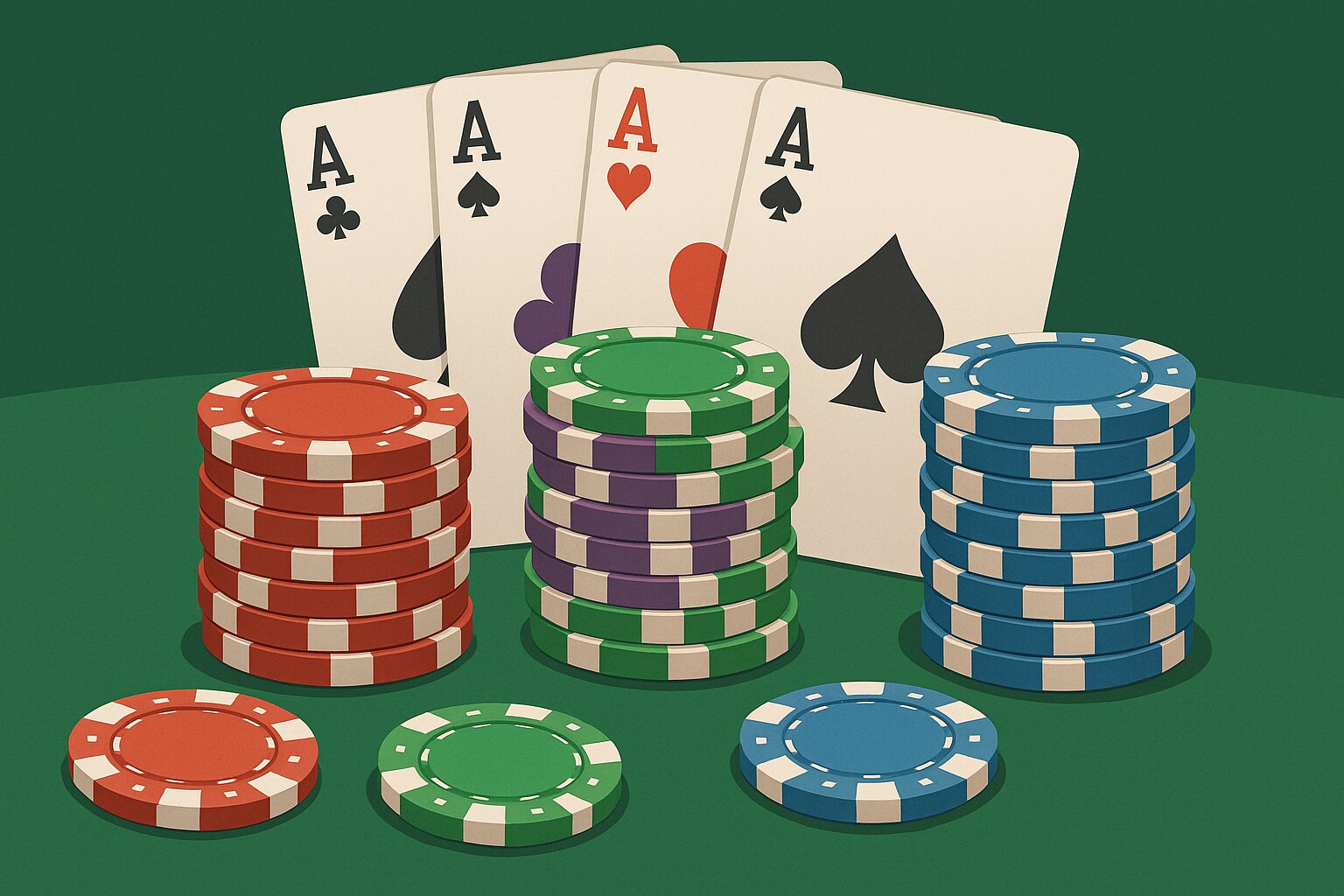
Planning a poker night at home? Getting the right number of chips is one of the first things to sort out, and it’s worth doing well so the game stays fair and easy to follow.
Poker should always be a friendly game played for entertainment among adults, in a safe, legal setting. This guide explains chip amounts and setups so your evening runs smoothly while keeping play responsible.
Ready to get your chips in order? Read on for clear, practical advice.
What Is the Standard Number of Poker Chips Per Player?
A useful guideline for most home poker games is to give each player between 50 and 100 chips. That range usually provides enough low-value pieces for the small wagers that appear often, a reasonable number of mid-value chips for regular betting, and a few high-value chips for larger pots and late-stage play.
Typically you’ll see sets with three or four colours. Home games work well with three denominations because it keeps things simple: plenty of the lowest-value chips, fewer of the medium ones and only a handful of the highest-value chips. For example, a comfortable per-player allocation might be about 30–40 low-value chips, 10–20 mid-value chips and around five high-value chips. Those proportions help keep stacks manageable and make it easier to count at the table.
If you prefer to tweak things, adjust the numbers to match your group’s style or the format you’re running. The aim is an even, understandable mix so players can focus on the game itself.
How Does Game Type Affect Poker Chip Requirements?
Game format changes how chips are used. In cash games, every chip corresponds to a fixed cash value and players may add or remove buy-ins as they wish, so you generally want denominations that reflect the cash stakes and avoid extremely high values. Keeping more chips in smaller denominations helps cash games move along without frequent changeovers.
Tournaments use chips only as a measure of tournament standing; they don’t represent real money. Players start with an agreed stack and blinds increase over time, so a tournament requires lots of lower-denomination chips to allow building and re-stacking during the early and middle stages. Sit & Go or mini-tournaments follow the same idea but on a smaller scale, so you still need enough small-value chips to support rising blinds without forcing players out prematurely.
Choosing values and quantities with the format in mind keeps betting clear and helps the structure unfold as intended.
How Many Poker Chips Are Needed for Different Player Numbers?
The total number of chips you’ll need depends on how many people are at the table and whether you expect the game to run long or end quickly. Below are practical totals and sample per-person mixes to give you a starting point.
For 4–5 players: aim for roughly 250–300 chips in the set. That allows each player a mix such as 40 low-value, 10 medium-value and 5 high-value chips, producing even stacks without excess clutter.
For 6–8 players: around 400 chips is a sensible target. This supports allocations like 40 low, 15 medium and 5 high per player, which keeps action moving while still giving room for larger pots.
For 9–10 players: plan on close to 500 chips. Here you might use 40 low, 15 medium and 10 high per player, with a few extra high-denomination chips retained for late-game needs.
If your set has a fourth colour, you can reserve a small number of those as top-tier chips for final hands or tie-breakers. Whatever totals you choose, the priority is a clear, consistent distribution so every player understands their stack sizes and values.
Choosing the Right Chip Colours and Denominations
Clear, distinguishable colours with sensible denominations make the table easier to read and betting simpler. A common approach uses three or four values: a low denomination for frequent small bets, a medium for standard betting, and a higher denomination for larger pots. If you add a fourth denomination, it should be rare and used mainly for big-action moments later in the game.
For example, you might use a white or blue chip as the base unit, a red chip at the next level, green as a mid-range value, and black for the highest commonly used chip. Labels or a short reference card at the table can help new players and speed up play. Keep the number of denominations limited so counting and trading chips stays straightforward.
Well-chosen denominations reduce errors and make it simpler for everyone to follow the flow of the game.
How Should Poker Chips Be Distributed at the Start?
Starting with equal stacks and a balanced mix of denominations sets the tone for a fair game. In a tournament format, prepare identical starting stacks in advance so each seat receives the same count and composition. In cash games, match chip mixes to each player’s buy-in so that chip values reflect the cash contributed.
Arrange chips in neat stacks in front of each player so counts can be checked quickly, and announce the denominations clearly before dealing begins. Doing this once at the start prevents disputes later and keeps the atmosphere focused on play rather than bookkeeping.
If a player needs to change their stack during a cash game, make any exchanges openly so everyone can see the adjustment. Transparent handling of chips reduces confusion and keeps the game steady.
What Are Common Mistakes When Deciding Poker Chip Amounts?
A few recurring setup mistakes are easy to avoid. Using too few chips forces constant change and can eliminate players early, whereas too many chips leads to slow, tangled play. Confusing colours or unclear denominations also cause delays and arguments.
Unequal starting stacks, even if unintentional, undermine fairness; taking a moment to count and compare stacks before starting is a simple fix. Another frequent issue is using too many different denominations, which complicates exchanges and makes it harder to follow the action.
Spotting these problems in advance—checking totals, simplifying denominations and ensuring even distribution—saves time and keeps the game enjoyable for everyone.
Transitioning from setup to kit selection, the next section covers what to look for when choosing a set for home use.
Recommended Poker Chip Sets for Home Games
A set of 300–500 chips in three or four colours suits most home groups. Look for a storage case so chips stay organised between sessions; that cuts setup time and prevents losses. For casual play, lighter plastic chips are fine; if you want a firmer feel, composite or clay-style chips mimic the experience of club play.
Consider how many high-denomination chips the set contains, and whether you can supplement with extras if needed. Sets that include a dealer button and a small instruction card for common denominations are handy for beginners.
Choose a set that matches the size and tone of your regular group rather than buying on impulse—this will make your evenings easier to run and more pleasant for everyone involved.
Tips for Storing and Managing Poker Chips
Proper storage keeps your set ready for the next game and reduces wear. Keep chips in a secure case and stack them by colour before packing away so setup is quicker next time. Store the case where adults can access it easily but away from children and unauthorised users.
Occasional cleaning and an inventory check prevent missing pieces and prolong the life of the set. If you regularly host games, label the case with the number of chips and colours inside; a short check before guests arrive will avoid last-minute scrambles.
With organised storage and a small maintenance routine, your chips will stay in good condition and each session will get off to a smooth start.
**The information provided in this blog is intended for educational purposes and should not be construed as betting advice or a guarantee of success. Always gamble responsibly.