
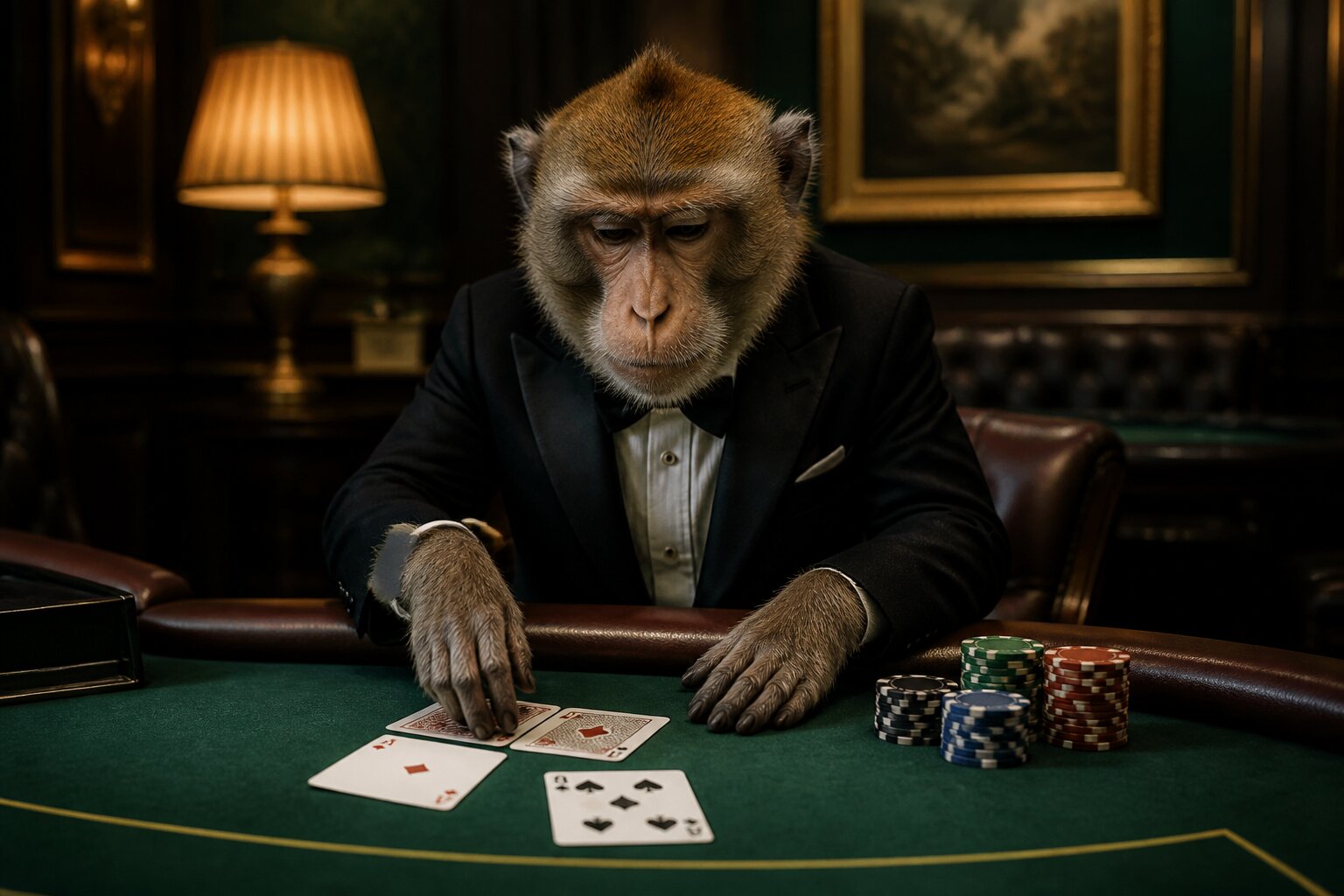
Ever wondered what players mean when they shout "monkey!" at the blackjack table? It sounds odd at first, especially if you’re new to the game.
Blackjack is full of colourful slang that can leave beginners puzzled. "Monkey" is one of those terms that keeps turning up—and it’s more practical than it seems.
Read on and you’ll learn what it means, where it likely came from, how players use it at tables and online, and why it matters when you’re trying to follow the action.
What Does "Monkey" Mean in Blackjack?
In blackjack, "monkey" is simply betting slang for any card worth ten points. That covers the 10, Jack, Queen and King. Because these four ranks all carry the same value, players treat them as a single group when talking strategy or reacting to a deal.
People usually call for a "monkey" at moments when a ten-value card will change the situation—such as when an Ace can be combined with a ten to make blackjack, or when a doubled-down hand needs a strong final card. Players may vocalise or gesture while the dealer reveals a card; the word is shorthand for the specific outcome they want to see.
Roughly one third of the deck is made up of ten-value cards, so it’s natural that they figure heavily in both play and table chat. That prevalence also explains why the term is familiar at tables around the world. If you want to know where the term came from next, the origins give a few plausible hints.
Origins of the Term "Monkey" in Card Games
The precise origin of "monkey" in card play isn’t settled, but a few reasonable theories exist. One suggestion points to East Asian gambling hubs where Western-style casino games mixed with local language and slang; words for "monkey" in some languages may have sounded similar to descriptors used for face cards, and the nickname could have migrated into English through that route.
Another idea draws on older British betting slang: in the past, "a monkey" could mean £500 in certain circles. That playful, informal usage may have made the word attractive as a nickname for high-value cards with distinctive pictures. Neither theory is proven by hard evidence, yet both show how social language and gaming culture can feed each other.
Whichever route it took, the term stuck because it’s short, memorable and useful at a busy table. Next, we’ll look at how players actually use it in a casino setting.
How "Monkey" Is Used in Casino Betting Slang
At the table, calling for a "monkey" is a quick way of signalling that a ten-value card is desirable right now. You’ll hear it when a player has an Ace and wants a ten for a blackjack, when someone has doubled down and needs a strong single card, or when a group watches the dealer’s next draw with keen interest.
The phrase also appears when the dealer is about to reveal a hole card; a ten can sometimes push the dealer over 21, so players might voice their anticipation. In other games where a ten-value card is useful, the same slang can turn up, especially in places with table chat and a social atmosphere. The word helps make the round feel communal without affecting how the cards are dealt.
This leads naturally into a short reference: which exact ranks are regarded as “monkey” cards.
Monkey Cards: Which Cards Count as Monkeys?
In blackjack, “monkey cards” are simply all the cards with a value of ten. Whenever you hear someone ask for a monkey, these are the cards they mean:
- 10: The numbered card marked with 10, valued at ten points.
- Jack (J): A face card, worth ten points.
- Queen (Q): A face card, worth ten points.
- King (K): A face card, also worth ten points.
Each of these contributes identically to making strong hands such as blackjack or high totals, which is why they’re grouped under the same nickname. Knowing this grouping makes it easier to follow table talk and to understand why players react strongly when one of these cards appears—next we’ll explain those reactions in more detail.
Why Do Players Shout "Monkey" at the Blackjack Table?
Shouts of "monkey" are a form of table reaction. They express anticipation for a ten-value card during important moments, and they help create a shared, lively tone among players. When several people are invested in the same outcome—say, a player’s doubled hand or the dealer’s next card—a vocal reaction is a simple way to join the moment.
This behaviour isn’t about influencing the deal; it’s part of the social ritual of play. Players celebrate favourable draws, tease one another, and mark turning points in a round through short calls or noises. The word "monkey" is compact and expressive, so it’s an easy choice when a ten-value card would make a notable difference.
If you’re wondering whether the term is only for live tables or whether it appears online too, the next section looks at how slang transfers to digital play.
Common Misconceptions About Monkey in Blackjack
New players sometimes misunderstand "monkey" and what it implies. Common errors include:
- Thinking “monkey” refers only to face cards; the 10 is included too.
- Believing it denotes a special card type, side bet or rule; it’s simply slang for ten-value cards.
- Assuming chanting or shouting changes the outcome; it does not influence the cards or the rules.
- Confusing it with non-card meanings of "monkey" in other contexts, such as historical betting slang.
Clearing up these points helps keep expectations realistic and makes table talk easier to follow. With that cleared up, the final piece to consider is how the term survives in online play.
Playing Blackjack Online: Does "Monkey" Translate to Digital Play?
Online blackjack changes how players interact, but the language survives—especially in live dealer formats. With standard software-based tables there’s little opportunity for chat, so slang rarely appears during those sessions. The player experience is focused on the interface rather than conversation, which reduces the chances of seeing table expressions typed out.
Live dealer streams recreate the social elements of a casino. A chat box lets players type “monkey!” or short reactions as the dealer deals real cards on camera. That preserves much of the atmosphere of a physical table even though the interaction is typed rather than shouted. Operators encourage civil, fair chat and expect players to stick to responsible play, so slang remains a bit of social colour within those rules.
Whether at a felt table or in a live stream chat, knowing what “monkey” means helps you follow the action and join in without feeling out of place. The term is a small piece of blackjack culture, but it’s one that makes conversations at the table quicker to read and more fun to follow.
Explore Casino Games at Bonanza Slots
Step into our site and see what’s waiting for you – there’s plenty of choice when it comes to casino games at Bonanza Slots. We welcome everyone who enjoys a little variety and a relaxed environment.
Getting started is straightforward: just create your account, make a deposit and you’ll be ready to explore our selection. We look forward to seeing you enjoy your time with us.
**The information provided in this blog is intended for educational purposes and should not be construed as betting advice or a guarantee of success. Always gamble responsibly.