
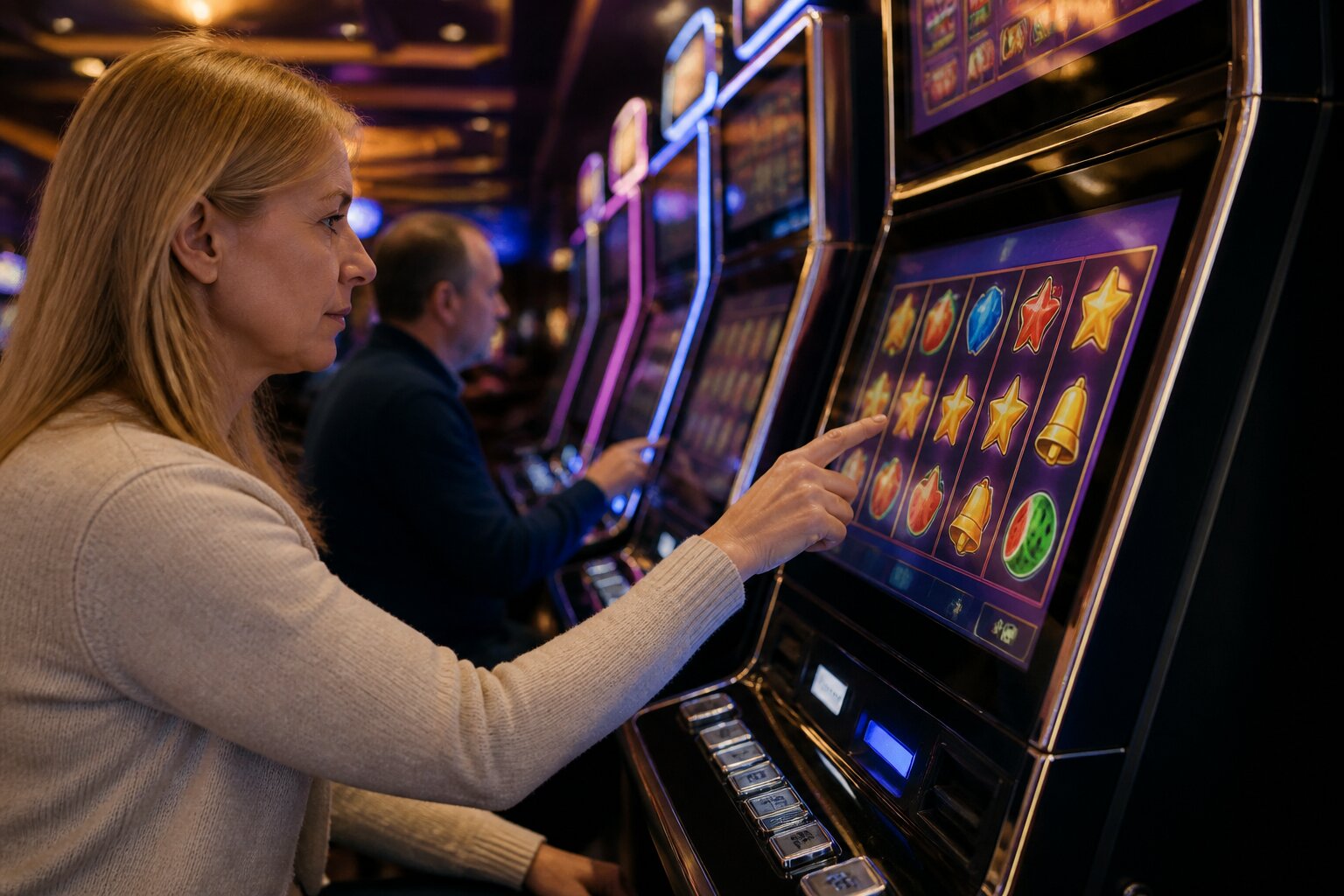
Have you ever watched someone tap at a slot machine screen and wondered what they hope to achieve? It’s a small, common gesture that raises bigger questions about habit, emotion and how people engage with games.
This article explores the reasons behind the behaviour, what it says about players’ thinking, and how game design and social settings shape those little rituals. Read on to find a clearer picture of why tapping happens and what it actually means for play.
Common Reasons People Tap on Slot Machine Screens
People tap for a mix of personal and situational reasons, and those reasons often overlap.
Some tap out of habit or to keep their hands busy, similar to fiddling with a pen. Others develop rituals that make play feel familiar and controlled. There’s also the emotional side: tapping can be a physical outlet for excitement or tension while reels are spinning.
Social signals play a part too. If you see other players tapping, you may adopt the behaviour simply because it seems part of the experience. The design of modern machines, which encourages interaction, can amplify that tendency.
Although these motives vary, the common thread is that tapping is a human response to anticipation and engagement rather than an action that changes the game’s mechanics. That difference is important to understand as you read on.
Does Tapping a Slot Machine Affect the Outcome?
Tapping does not change the outcome of a spin. Trusted, regulated games use systems that determine results independently of any physical gestures players make after initiating a spin.
When a spin starts, the result is already set by the game’s internal processes. Any touching of the screen afterwards is an expression of the player’s state of mind, not a factor in the result. This separation is central to how fairness is maintained in regulated games.
Understanding this helps set realistic expectations while playing. It also clarifies why operators focus on ensuring transparent, consistent mechanics rather than reacting to individual player behaviours.
Psychological Factors Behind Tapping Behaviour
Several psychological mechanisms explain why people tap, and they show up in many chance-based activities.
Perceived control is one. Humans often try to impose patterns on uncertain situations; tapping can give a momentary sense of agency even when outcomes are fixed. Rituals create comfort and predictability, and repeating the same action can feel reassuring in an otherwise unpredictable setting.
Arousal and focus are also relevant. The act of tapping may help channel nervous energy, heighten engagement with the game, or keep attention anchored on the screen. These responses are natural and tell us more about how players experience games than about the mechanics themselves.
If patterns like tapping become part of heavier-than-intended play, that can be a signal to pause and reassess how much time or money someone is spending. Noticing the context of a habit is as useful as recognising the habit itself.
Is Tapping on Slot Machines a Myth or Misconception?
The idea that tapping changes the result is a misconception. That belief sparks many anecdotes and rituals, but it does not match how regulated games operate.
Games are programmed so each outcome is independent of post-spin input. Superstitions and stories may persist because people naturally seek explanations for wins and losses, and rituals can feel meaningful even when they do not alter results.
Accepting that tapping is symbolic rather than functional makes it easier to separate what players feel they are doing from what the game actually does. That distinction clarifies the experience without stripping away the social or emotional reasons people enjoy certain rituals.
How Casinos Respond to Player Behaviour
Casinos recognise that players have habits and will often tolerate harmless gestures like tapping as part of game culture. As long as actions do not damage equipment or disturb others, staff typically do not intervene.
Operators prioritise fair play and robust game design so that all players compete on equal terms. Their role is to maintain that integrity and to provide a safe environment where people can enjoy games without misplaced expectations about how outcomes are produced.
If a behaviour signals a problem, such as disruptive conduct or signs of problematic play, staff may offer help or additional support options. This approach keeps the focus on a fair experience for everyone.
We’ll now look at how social context shapes these habits and what that means for players and onlookers.
Social Influences and Superstitions
Social context has a strong influence on tapping and similar behaviours. People learn by watching others, and rituals can spread quickly in environments where many people play the same games.
When groups adopt a habit, it can feel like part of the shared experience. That social reinforcement makes rituals stick even when there is no effect on the result. Sometimes the behaviour is playful, sometimes it’s part of a group’s identity while playing.
Operators monitor player behaviour not to judge but to support safe play. If a pattern suggests someone is struggling, staff can provide information about tools and support. Encouraging awareness of how one plays helps keep gaming a controlled pastime rather than something that causes harm.
The Influence of Technology on Player Interaction
Touchscreens and immersive interfaces make interaction feel natural, so tapping can seem built into the experience. Designers increasingly use haptic feedback, simple visual cues and direct-manipulation controls to create a sense of immediacy. These choices help players feel in control and reduce friction when moving through menus or triggering on-screen actions.
Game designers add interactive elements to keep players engaged and to make the interface more satisfying to use. Accessible layouts, clear affordances and predictable responses all contribute to a smoother experience. Small, polished interactions can also reduce frustration, making it easier for new players to learn the rules and for returning players to stay involved.
These features enhance the user experience without adding a performance advantage. They aim to make games accessible and enjoyable, so tapping becomes part of the interaction vocabulary rather than a functional tactic. As technology evolves, gestures will continue to shape how players relate to games, and new input methods may broaden who can play and how they participate.
That makes it useful to recognise the difference between interface-driven engagement and actions that actually affect outcomes. Players and designers both benefit from understanding whether an action is purely cosmetic or has gameplay consequences, so expectations remain clear and experiences remain fair.
Is Tapping Seen in Other Gambling or Gaming Activities?
Yes. Tapping and similar behaviours appear in many digital activities that use touch interfaces, from online bingo to mobile skill games and social casino apps.
Developers include interactive options to improve accessibility and enjoyment, not to create new ways to influence results. These options can make a game easier to play on smaller screens, speed up routine actions, or add social features, while the underlying outcome mechanisms remain separate from the player’s screen gestures.
Across these formats, the mechanics that determine outcomes are distinct from the gestures players use while interacting with the screen. Random number generation, server-side logic or predefined game rules decide results, and tapping is simply the way players trigger available options.
Recognising this helps players transfer their understanding from one format to another. Tapping is part of the play style and social scene, a form of interaction and expression, not a method of securing a particular result. It can influence user experience, not the fairness or randomness of game outcomes.
Responsible Gambling and Healthy Play Habits
Enjoying games safely means being aware of the difference between play rituals and the actual mechanics of outcomes, and ensuring those rituals do not become a substitute for sensible limits.
Healthy habits include setting budgets and time boundaries, taking breaks, and reflecting on why you play. If play patterns start to feel compulsive, there are tools available such as deposit limits, session reminders and self-exclusion schemes. Operators provide these options to help people keep play within comfortable bounds.
We encourage you to treat gambling as entertainment and to use the support tools provided if you ever feel your play is shifting from casual to problematic. If you want guidance or would like to adjust your play settings, our site offers easy access to those tools and to professional support services.
**The information provided in this blog is intended for educational purposes and should not be construed as betting advice or a guarantee of success. Always gamble responsibly.