
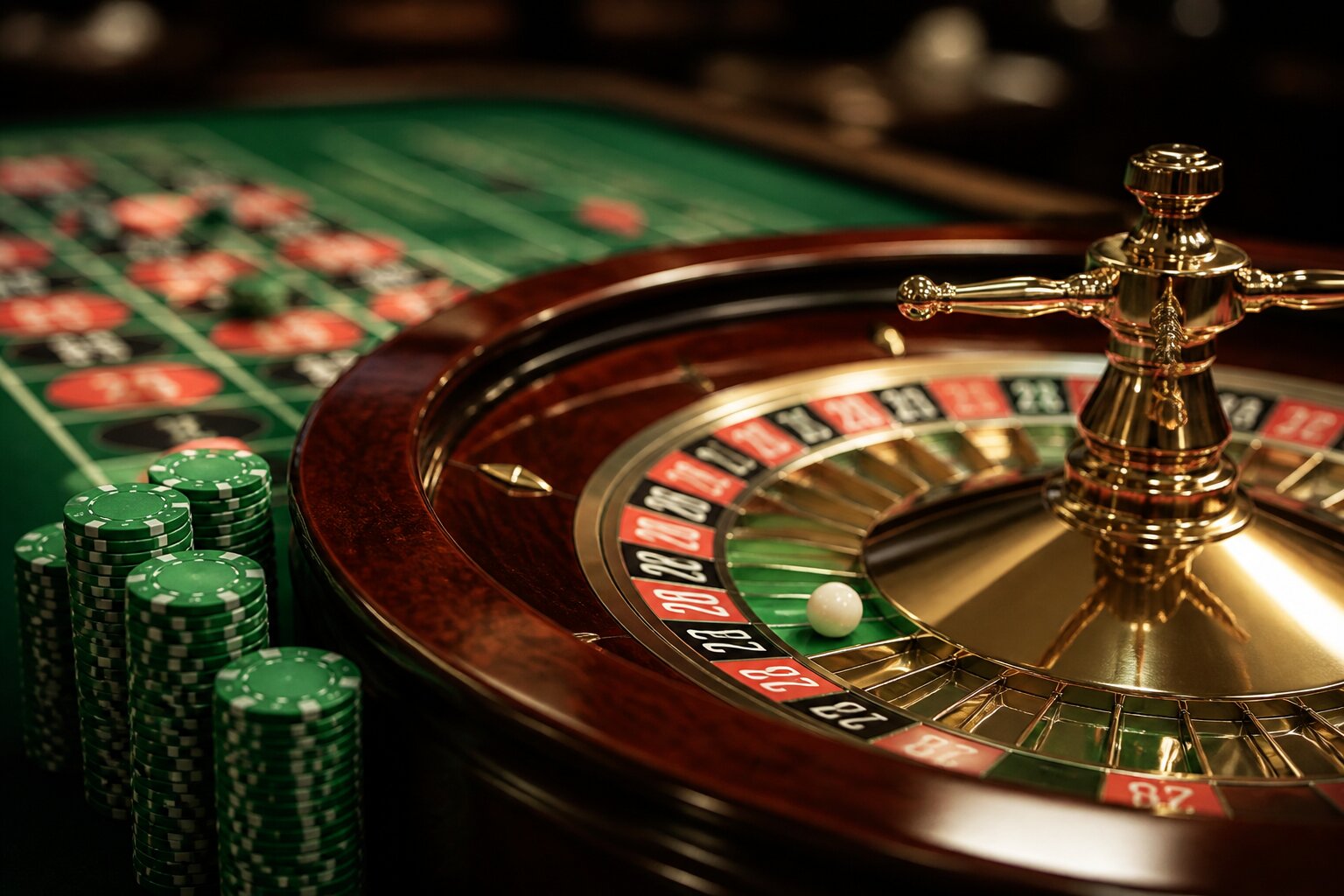
Roulette is a game of clear rules and simple outcomes, yet one colour on the wheel always draws attention—green. Whether you’re new to the wheel or have watched many spins, that small green slot can change how bets pay out and how the game plays out.
This article explains what the green spaces are, how they affect payouts and odds, and common misunderstandings so you can read the table with confidence. Keep reading to see how a single pocket shapes the whole game.
What Are the Green Spaces on a Roulette Wheel?
The green spaces on a roulette wheel are the pockets that hold the zeroes. In European and French roulette there is a single green slot marked ‘0’. In American roulette there are two green slots, marked ‘0’ and ‘00’. Their placement on the wheel is deliberate: they sit among the numbered red and black pockets, breaking the symmetry of colour and number groups.
These green pockets are not part of the red/black or odd/even categories used by many outside bets. That difference is what makes them pivotal: they change how many possible winning outcomes exist for different bet types. For example, a straight bet placed solely on the green ‘0’ covers one possible outcome out of the wheel’s total pockets, so its payout and probability differ from bets covering multiple pockets.
Knowing which variant you are playing matters because the number of green slots influences both the probability of a given number appearing and the long-term mathematical advantage the house holds.
Why Do Green Numbers Matter in Roulette?
Green numbers matter because they alter the balance between player-facing bets and the house. Even-money bets—like red/black or odd/even—assume two possible states, but the green pocket creates a third state that causes those bets to lose when it appears. That structural difference is the reason the casino retains an edge.
Beyond that, green pockets change the risk-reward profile across the table. Inside bets that target a single number pay much more when successful because they cover fewer outcomes; green is treated the same way as any other single-number bet in that respect. At the same time, because the green pocket removes some winning possibilities for broader bets, it raises the difficulty of those bets paying out.
So, green pockets are not merely decorative: they are a core part of how roulette balances payouts against probability.
How Does the Green Pocket Affect Payouts?
Green pockets affect payouts in two main ways. First, they reduce the chance of winning on even-money bets because those wagers do not include green as a winning outcome. Second, when a player bets directly on a green number, the payout is substantially larger than for outside bets to reflect the small probability of success.
A common example is the Straight Up bet: a single-number bet placed directly on ‘0’ or ‘00’. The standard payout for a Straight Up win on any single number, including green, is 35 to 1. Practically, a £1 Straight Up win returns £36 in total. By contrast, an even-money bet that wins pays 1 to 1.
Because green pockets reduce the frequency of winning for many common bets, they have an indirect effect on expected returns across the table. The fewer green pockets there are, the closer some bets come to even odds; more green pockets widen the gap.
Understanding Payout Ratios for Green Bets
Payout ratios show how much a winning bet returns relative to the stake. For single-number bets, including on green, the ratio is 35 to 1 in standard roulette rules. That same ratio applies whether the number is green, red or black; the difference is the probability each number will appear.
Comparing a bet on green with an even-money bet highlights the trade-off between payout and probability. A Straight Up bet targets one number and pays 35 to 1; an even-money bet covers roughly half the wheel’s non-green numbers and pays 1 to 1. The larger payout for single-number bets compensates for their lower chance of occurring.
To put this in context with the wheel types: in a European wheel of 37 pockets, a single-number bet has a probability of 1 in 37. In an American wheel of 38 pockets, a single-number bet has a probability of 1 in 38. Those probabilities underpin why the payout ratios are set as they are and how expected returns differ between wheel types.
Comparing Payouts: Green vs Red or Black
A Straight Up bet on green pays the same ratio as any other single number—35 to 1—but the probability of winning depends on the wheel variant. By contrast, a red or black bet covers 18 pockets on a European wheel and 18 on an American wheel, excluding the green(s); these even-money bets pay at 1 to 1.
Because green pockets occupy one or two of the wheel’s pockets, they reduce the frequency at which even-money bets win. That is why a bet paying 1 to 1 is still less favourable overall than it might appear at first glance: the occasional green outcome causes more even-money losses than a purely binary red/black setup would.
This comparison clarifies the trade-offs: higher payouts for single-number bets reflect lower win probability, while even-money bets pay less but succeed more often—though still subject to the influence of green pockets.
House Edge: How Green Impacts Your Odds
The house edge is the long-term statistical advantage the game holds. Green pockets are the principal cause of that edge in roulette because they create outcomes that take money off the table from common bets.
Understanding the house edge helps players compare variants and make informed staking decisions.
In European roulette, where only a single ‘0’ is present among 37 pockets, the house edge is approximately 2.7%. In American roulette, with both ‘0’ and ‘00’ among 38 pockets, the house edge increases to about 5.26%. Those figures are derived from comparing the fair mathematical return of bets to their actual payouts, given the total number of outcomes.
Understanding the house edge helps set realistic expectations about returns over many spins. It explains why occasional wins—even sizable ones—do not change the long-term statistical advantage built into the game.
Do All Roulette Variants Have Green Spaces?
Standard roulette variants all include at least one green slot to hold a zero. European and French roulette contain a single ‘0’, while American roulette includes both ‘0’ and ‘00’. Specialty or novelty versions of roulette sometimes change the number of green pockets or introduce altered rules, but such versions are not the norm.
Knowing which variant you are encountering matters because the number of green pockets affects both payout frequency and house edge. Players often prefer the single-zero versions for slightly better mathematical odds, while the double-zero version is more common in certain classic casino environments.
If you encounter an unfamiliar variant, checking the wheel’s layout and the rules for how zeroes are treated will immediately clarify how payouts and odds will differ from the standard formats.
Common Myths About Green Payouts in Roulette
There are several persistent myths about green payouts that can cloud judgement. It helps to separate these misconceptions from the mathematical reality of the wheel.
Myth: Green is “due” after a run of reds or blacks.
Fact: Each spin is an independent event; previous outcomes do not change the probability of a future spin.
Myth: Betting on green is an easy way to win big.
Fact: Although single-number payouts are large, their probability is small; the payout compensates for that low chance.
Myth: The house has no edge on green bets.
Fact: The presence of green pockets is precisely what creates the house edge; it affects all players’ expected returns regardless of the bet chosen.
Knowing these points keeps expectations grounded and helps maintain a clear view of how the game behaves over time.
Summary: Key Points About Green Payouts
Understanding green payouts helps make sense of how roulette distributes risk and reward. Green pockets—single ‘0’ or double ‘0’—change the odds for many common bets and are the source of the game’s house edge. Single-number bets, including those on green, carry large payouts to reflect their low probability, while even-money bets lose when green appears. Separating myth from fact and recognising how different wheel variants affect probabilities will give you a clearer picture of what to expect at the table.
If you have questions about a particular roulette rule or want clarity on how a specific bet will pay out, this site is here to help. Keep play controlled, know the version you’re facing, and enjoy the game with clear expectations in mind.
**The information provided in this blog is intended for educational purposes and should not be construed as betting advice or a guarantee of success. Always gamble responsibly.