
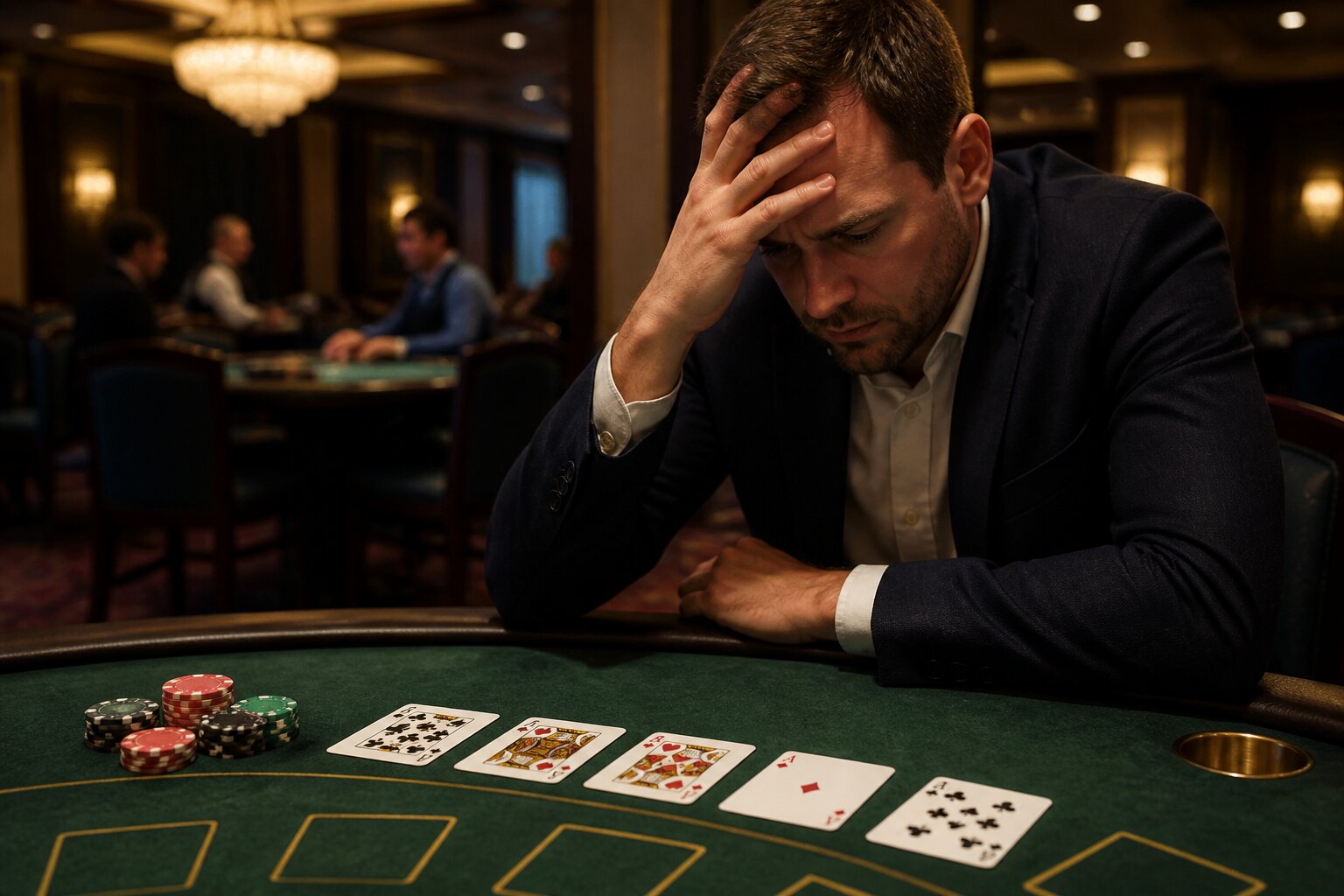
Ever wondered why a losing streak at blackjack can feel so relentless? If you’ve found yourself stacking chips on hand after hand, only to see the dealer prevail each time, you’re not alone.
Knowing the numbers behind consecutive losses can change how you approach a session — not to promise wins, but to set realistic expectations and make measured decisions.
Read on to discover how those streaks form, what affects their likelihood, and how to interpret those runs when they happen.
Understanding Blackjack Probabilities
Blackjack combines player decisions with fixed game mechanics, and that mix determines the probabilities for any single hand. In many common rule sets — dealer stands on all 17s and blackjack pays 3:2 — a basic strategy player typically wins about 42–44% of hands. The dealer wins roughly 48% of the time, with the remainder being ties or pushes.
Individual choices such as hitting, standing, splitting or doubling down change the immediate risk for a hand. For example, standing on 16 versus a dealer 10 carries a high chance of losing; choosing to hit instead raises the risk of busting, so neither option is clearly superior in that situation. These decision-driven shifts alter short-term outcomes but do not erase the house edge that shapes long-run results.
This background on single-hand probabilities is the foundation for calculating streaks, so next we’ll look at the straightforward maths that turns one-hand chances into multi-hand odds.
How Are the Odds of Consecutive Losses Calculated?
Calculating the chance of losing multiple hands in a row starts with the probability of losing a single hand. Once that figure is known, the probability of N consecutive losses is the single-hand loss probability raised to the power of N.
For example, if the probability of losing one hand is 48% (expressed as 0.48), the chance of losing five hands in a row is 0.48 to the power of 5: 0.48^5 = 0.048, or 4.8%. This assumes each hand is independent and that the loss probability stays constant from hand to hand, which is a useful approximation for most casual play and many digitally shuffled games.
That method works for any streak length; the next section applies it to a few common streaks so you can see how quickly probabilities fall as the number of hands rises.
Key Factors That Influence the Calculation
Several elements can alter the single-hand loss probability used in the calculation. Table rules (for example, whether the dealer hits on soft 17), how many decks are in play, and specific payout rates all change the house edge slightly and therefore the chance of losing any given hand.
Player decisions matter too. Using basic strategy reduces the house edge compared with random play, while deviations from that strategy change the single-hand loss rate and thus the computed streak probabilities.
The Role of House Edge and Deck Composition
The house edge is the long-term advantage the casino maintains through rules and payouts. Deck composition affects short-term odds because the mix of remaining cards shifts as cards are dealt. In single-deck games the composition effect is stronger, whereas in well-shuffled multi-deck games the per-hand probabilities remain more stable. In practice, most casual sessions and digitally shuffled games use the constant-probability assumption as a reasonable approximation.
With that framework in place, the next section shows worked examples to make the maths concrete.
Real Examples: Losing Streak Odds in Practice
To see how the calculation looks in practice, use the common estimate of a 48% loss chance per hand and raise it to the power of the streak length. This assumes each hand is independent and that the probability stays constant from one hand to the next. The numbers fall off quickly as the streak grows, showing how rare longer runs become under that simple model.
Calculating Your Own Chances Step by Step
Here are a few representative calculations using 0.48 as the single-hand loss probability.
Losing 3 hands in a row: 0.48^3 = 0.110 → about 11%
Losing 5 hands in a row: 0.48^5 = 0.048 → about 4.8%
Losing 7 hands in a row: 0.48^7 ≈ 0.024 → about 2.4%
These examples illustrate that short losing runs are fairly common, while longer runs become increasingly unlikely. They are useful for setting realistic expectations during a session, but they do not predict any single future outcome. Keep in mind the assumption of independence; in games where card removal matters, the exact figures shift, which is what the following section explores.
Common Scenarios Players Encounter
Players often notice a few recurring patterns during sessions: a run of early losses, several defeats following sporadic wins, periods where the dealer wins repeatedly, or short loss streaks mixed with break-even hands. Each observation can be fitted to the same basic probability framework, with small variations introduced by table rules and play style. Not every session will match the simple model precisely, but it remains a useful baseline for understanding what is and is not unusual.
Next, we will look at how changing table conditions alter those single-hand probabilities and therefore the streak calculations. That discussion shows how rule differences, number of decks and player decisions can subtly change the odds.
Does Table Variation Affect Your Odds?
Yes—table rules and the number of decks in use change the underlying single-hand probabilities, which in turn affect streak odds. Single-deck games generally reduce the house edge slightly compared with six- or eight-deck games; that might change the loss probability from, say, 48% to around 47% in certain sets of rules. Though the difference for a single hand is small, it compounds across multiple hands when you raise the probability to a power.
Other rule differences also matter. If a dealer must hit on soft 17, the house edge increases a little, nudging the loss probability higher. Variations in double-down or split rules and different blackjack payout rates similarly shift the baseline chances. Knowing how a particular table is configured helps to set more accurate expectations for both single hands and streaks.
Understanding these table effects rounds out the picture of why streaks happen and why they sometimes feel more dramatic than the maths suggests, which brings us to the psychological side of losing runs.
Why Do Losing Streaks Feel So Common?
Streaks attract attention because human perception amplifies negative outcomes. Negative experiences tend to be remembered more vividly than neutral ones, so a sequence of losses stands out even if the overall session is close to break-even. At the same time, a common misperception is that previous hands influence future ones; blackjack hands are independent in the short term, so past losses do not change the mathematical odds of the next round.
These mental patterns can make short disappointing runs feel longer or more meaningful than they are. Recognising that emotional reactions do not alter the probabilities helps keep perspective. Set sensible time and money limits, and treat sessions as entertainment rather than a way to recover losses — that approach keeps decision-making clearer when a streak occurs.
This final point ties the discussion together by emphasising perspective: knowing the numbers helps you interpret streaks calmly and continue playing with awareness and self-control.
Play Online Casino Games at Bonanza Slots
We invite you to be part of our welcoming community at Bonanza Slots, where players come together for an enjoyable casino experience in a friendly atmosphere. There’s something special about sharing good times with others who enjoy a great game just as much as you do.
Getting started is simple—just create an account and make a deposit to begin playing. We look forward to seeing you around and hope you have a fantastic time on our site.
**The information provided in this blog is intended for educational purposes and should not be construed as betting advice or a guarantee of success. Always gamble responsibly.